The chair is not quite the problem. The hours are. Desk work arrives in long, unbroken blocks — a report, a call, the call after that — and the body spends them almost perfectly still. The fashionable name for the remedy is the "exercise snack": a minute or five of movement, taken often, in place of an hour taken once. Strip away the branding and it is an old instruction. Get up, and get up again.
In 2023, Andrea Duran, Keith Diaz and colleagues at Columbia sat eleven middle-aged and older adults in a laboratory chair for eight hours on five separate days, changing only how often they rose for light treadmill walking. Five minutes of walking every half hour was the only schedule that significantly blunted the day's rise in blood glucose; by the researchers' account, the spike after a large meal was 58% smaller than when the same people sat straight through. Every walking schedule lowered systolic blood pressure, by roughly four to five points, and most of them eased fatigue and lifted mood. None of them changed performance on cognitive tests.
A larger picture comes from the wrist. In 2022, Emmanuel Stamatakis and colleagues analysed accelerometer data from 25,241 UK Biobank adults who reported no leisure-time exercise at all, looking for short bursts of vigorous everyday movement — a hurried flight of stairs, a fast walk to catch something — most of them lasting under a minute. Over roughly seven years of follow-up, those who managed about three such bursts a day had a 38–40% lower risk of death from any cause or from cancer, and a 48–49% lower risk of cardiovascular death, than those who managed none.
Read both modestly. The Columbia trial is small, measured single days in a laboratory, and tells us about blood sugar and blood pressure rather than long-term health. The Biobank study is observational: people who are already healthier may simply climb faster, and no amount of statistical care fully removes that doubt. Neither shows that a minute on the stairs replaces regular exercise. If you live with a heart condition, uncontrolled blood pressure, or painful joints, ask a clinician before adding vigorous bursts to the day.
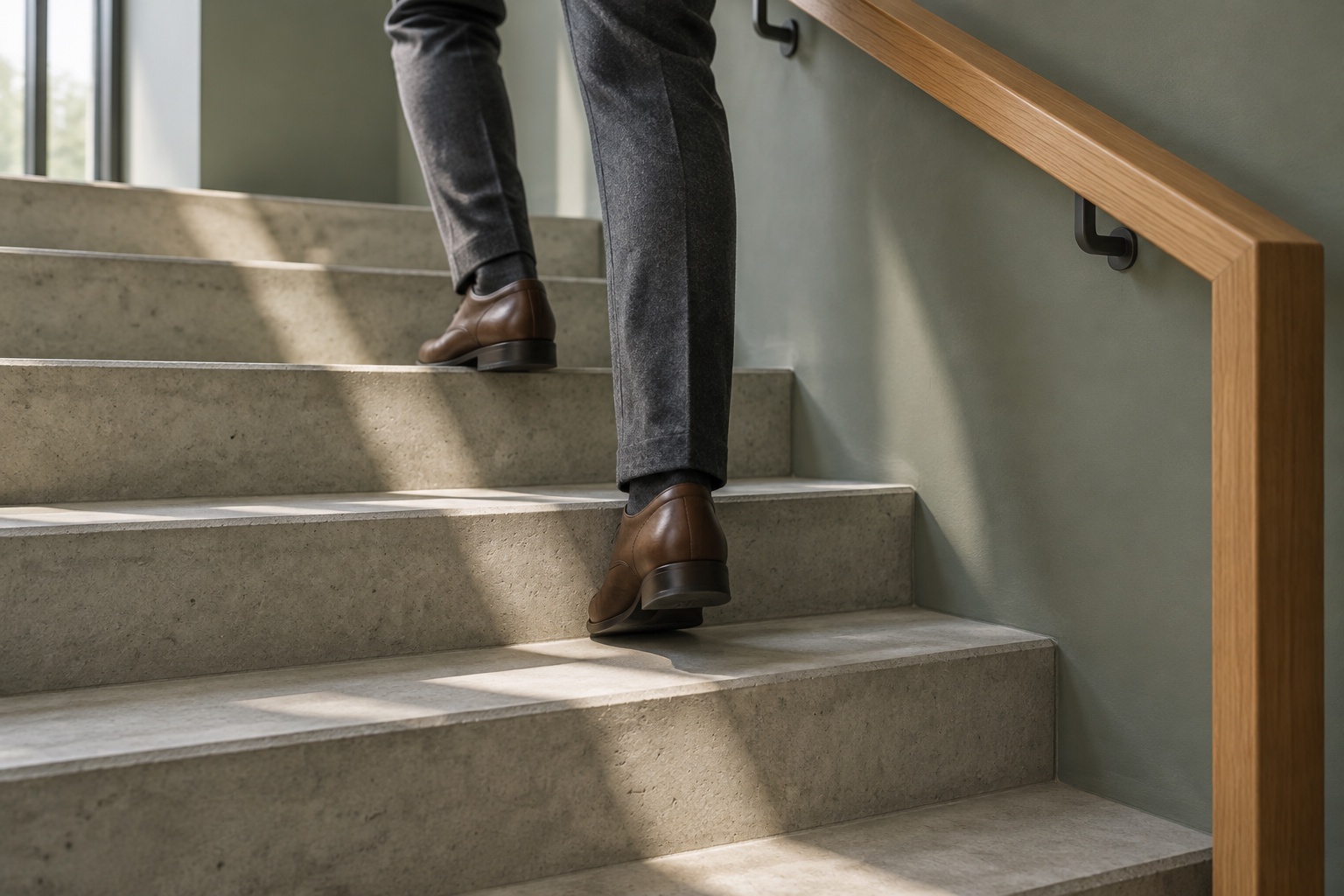
The practice: set a quiet timer for every thirty minutes of sitting. When it sounds, stand and walk for five — down the corridor, around the floor, to the far printer and back. Take calls on your feet when the camera is off. Two or three times a day, take a flight of stairs at a pace that leaves you a little short of conversation, then return to the desk. No kit, no changing room, no tracker required. The body was not built to stay put. It only asks to be interrupted.
Duran et al., Medicine & Science in Sports & Exercise (2023); Stamatakis et al., Nature Medicine (2022).